

Pierre Arthuis
Theoretical nuclear physics researcher
Chargé de recherche CNRS @ IJCLab, Orsay, France
About me
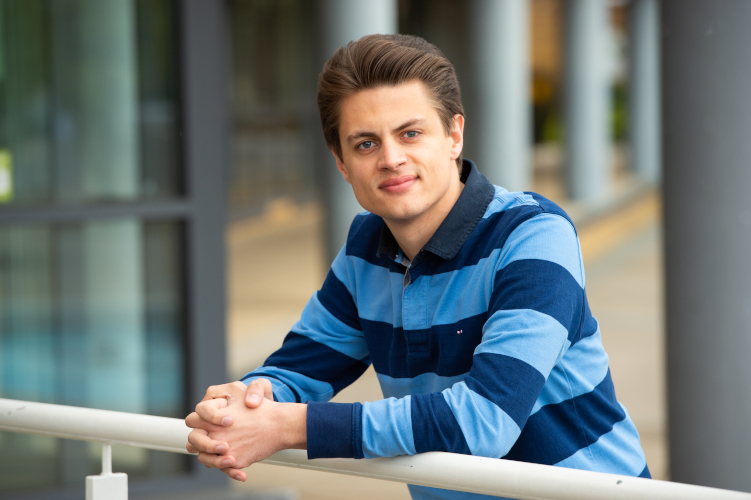
I am a low-energy nuclear theory staff researcher (Chargé de Recherche) at the Laboratoire de Physique des Deux Infinis Irène Joliot-Curie (IJCLab) in Orsay, France. The laboratory is located on the campus of Université Paris-Saclay and part of IN2P3, the Nuclear and Particle Physics Institute of CNRS. Prior to joining IJCLab, I obtained my doctorate from Université Paris-Saclay in 2018 under the supervision of Thomas Duguet and Jean-Paul Ébran at CEA Paris-Saclay and then was a post-doctoral researcher at University of Surrey with Carlo Barbieri and at Technische Universität Darmstadt with Achim Schwenk. I initially joined IJCLab as a Marie Skłodowska-Curie Fellow, before being promoted to staff in 2025.
My research is dedicated to the progress of ab initio methods for nuclear systems. They aim at describing finite nuclei or nuclear matter in an exact or systematically improvable way. I have worked on different many-body approaches, from deriving the formalism for Bogoliubov Many-Body Perturbation Theory to pushing Self-Consistent Green’s Functions towards heavier nuclei. Other efforts towards calculations of heavy nuclei include reducing the memory requirements for storing matrix elements at the two-body and three-body level and thus possibly accelerating calculations. I also extended the handling of three-body forces to tackle infinite matter with non-local interactions. Finally, I also developed new low-resolution interactions to predict bulk properties of nuclei. Such interactions based on chiral effective field theory present good convergence properties with respect to system size and many-body method expansion, which allows for accurate calculations at moderate cost.
One of my research interests is the automatisation of the development process of many-body methods. When designing and implementing a new formalism, or pushing it towards higher precision, a lot of time is spent on long, error-prone hand-made derivations and operations. This can be reduced by using the appropriate tools to let the computer take care of it. As part of this effort, I am the maintainer and main developer of ADG, an open-source Python package generating diagrams and expressions for several many-body methods. This work additionally led to progress in our understanding of many-body diagrammatics as well as automated-tools-supported introduction of new formalisms. Recently, it allowed the first fifth-order many-body perturbation theory calculations for infinite matter.
Where to find me online
Academic group page
The home page of the theoretical physics department at IJCLab in Orsay, as well as the page for the nuclear theory group.
Academic networks
Have a look at my OrcID, Inspire, GoogleScholar and ResearchGate pages.
Elsewhere
You can find my GitHub and LinkedIn pages as well as my email in the sidebar!